The short answer
Most counterfeits fail a caliper and a scale. Genuine bullion coins are struck to tight published tolerances, and fakes are almost never right on diameter, weight, and thickness at once. The exception is tungsten, whose density sits within 0.4% of gold — that one needs conductivity, ultrasound, or a surface-fingerprint scan to catch. Below: seven tests, ordered from free to forensic, with the specifications to measure against.
Ask in any bullion forum and you'll see the same post weekly — a photo of a bar, the caption "paid a lot of money, is this fake?", and forty replies of guesswork. It's a miserable position to be in after the money has left your account.
The good news is that verification is mostly unglamorous measurement, and you can do a surprising amount of it with a £15 caliper and a kitchen scale. Here's the sequence we'd actually use, and — just as important — where each test stops working.
What are the published specifications for common bullion coins?
Start here, because this single table catches the large majority of fakes. Mints strike to tight tolerances; counterfeiters working in cheaper metals cannot match gold's density, so getting weight right forces the dimensions wrong, and vice versa.
| Coin | Diameter | Gross weight | Fine metal | Purity |
|---|---|---|---|---|
| 1 oz American Gold Eagle | 32.70 mm | 33.931 g | 31.103 g | 91.67% (22k) |
| 1 oz Krugerrand | 32.77 mm | 33.930 g | 31.103 g | 91.67% (22k) |
| 1 oz Gold Maple Leaf | 30.00 mm | 31.10 g | 31.10 g | 99.99% |
| 1 oz Gold Britannia | 32.69 mm | 31.21 g | 31.103 g | 99.99% |
| Gold Sovereign | 22.05 mm | 7.98 g | 7.32 g | 91.67% (22k) |
| 1 oz American Silver Eagle | 40.60 mm | 31.103 g | 31.103 g | 99.9% |
| 1 oz Silver Maple Leaf | 37.97 mm | 31.11 g | 31.11 g | 99.99% |
Two things worth noticing. First, the 22-karat coins — Eagle, Krugerrand, Sovereign — weigh more than their fine gold content, because copper and silver are alloyed in for hardness. A Krugerrand containing exactly one ounce of gold weighs 33.93 g, not 31.1 g. People sell genuine coins cheap believing they're underweight.
Second, be careful with thickness. Published figures are measured over the raised relief, so a flat caliper reading across the middle will come in noticeably lower on a high-relief coin. Diameter and weight are far more reliable checks.
The Royal Mint describes the Sovereign as "the most tightly specified coin in the world," guaranteed to five decimal places. That precision is exactly what makes measurement such a good screen.
Test 1: The scale and caliper check (free)
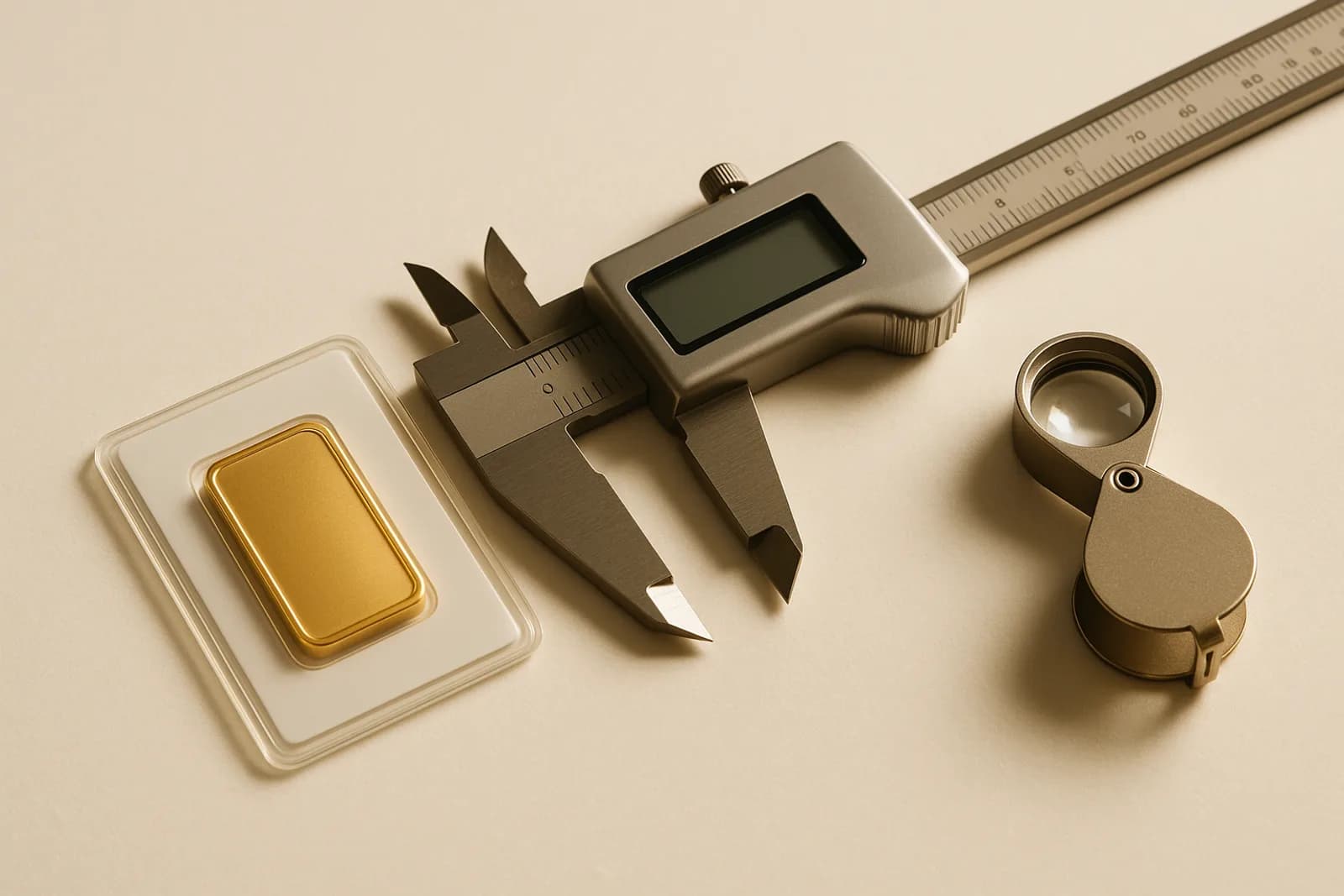
Weigh it on a scale accurate to 0.01 g and measure the diameter with digital calipers. Compare against the table above. A coin that is 2% light, or half a millimetre wide, is not a coin you should keep.
This alone eliminates most cheap fakes, which are typically brass, zinc, or lead-based. Their densities are so far from gold's that they cannot get both dimensions and mass right.
Test 2: The density test (free, needs care)
Weigh the item in air, then suspended in water. Density = weight in air ÷ (weight in air − weight in water). Water displaced by one cubic centimetre weighs one gram, which makes the arithmetic simple.
Reference densities in g/cm³:
| Metal | Density | Note |
|---|---|---|
| Gold | 19.32 | The benchmark |
| Tungsten | 19.25 | 0.36% from gold — the dangerous one |
| Lead | 11.34 | Easily caught |
| Silver | 10.49 | |
| Copper | 8.96 | Easily caught |
| Brass | 8.4–8.7 | Easily caught |
| Steel | ~7.85 | Easily caught |
Germany's Bundesbank published a worked example from its own counterfeit analysis: 41.728 g in air, 39.290 g in water, giving a volume of 2.438 cm³ and a density of 17.10 g/cm³ — against 17.13 for the genuine comparison coin. In another case, a fake 4-Ducat measured 8.40 g/cm³ against a genuine 18.97. Density caught that one instantly.
The limitation is right there in the table. Tungsten sits 0.36% below gold, comfortably inside the error margin of a home setup with surface tension and bubbles working against you. Density testing does not catch tungsten. Add a drop of washing-up liquid to break surface tension, and don't trust a result to better than about 1%.
Test 3: The magnet slide (free)
Gold and silver are diamagnetic — they should not stick to a magnet at all. Slide a strong neodymium magnet down a tilted silver bar and it should visibly brake, moving in slow motion.
That braking is eddy currents: the moving magnet induces circulating currents in the metal, which generate an opposing field. Silver is the most electrically conductive metal there is, so the effect is dramatic.
The honest caveat: copper is also highly conductive and slides slowly too, so this doesn't separate silver from copper alloys. And tungsten and lead aren't magnetic either, so a tungsten-cored bar sails through this test. Treat it as a quick way to rule out steel and nickel, not as proof of anything.
Test 4: The ping test (free)
Balance the coin on a fingertip and tap it — real silver rings with a long, clear, sustained tone; base metal thuds. The difference is audible even to an untrained ear once you've heard both.
Apps like Bullion Test and Pingcoin analyse the frequency through your phone's microphone against a reference database. One point of caution: you'll see confident claims that "silver rings at 1,200 Hz." Resonant frequency depends on geometry as much as metal, so it's coin-specific rather than a property of silver. The American Silver Eagle's commonly cited reference is around 6,145 Hz — a very different number, for the same metal.
Use the ring as a qualitative signal. Duration and clarity tell you more than any single frequency reading.
Test 5: Surface fingerprinting — PAMP VERISCAN (free, product-specific)
This is the strongest consumer-accessible check available, and it costs nothing. At production, PAMP photographs the microscopic surface texture of each bar — a random topology unique to that item, like a fingerprint. Scanning it later with the VERISCAN app matches it against the stored record.
What makes it powerful is that it cannot be cloned from a photograph the way a serial number can. It works through sealed CertiPAMP packaging, so you never break the seal, and scans have been free since September 2021. The technology holds LBMA accreditation under the Gold Bar Integrity programme.
If verification matters to you, buying a product that carries it is the simplest possible answer — for example the 1 oz PAMP Lady Fortuna Veriscan bar or the 10 oz Veriscan bar.
Test 6: Electronic verification — Sigma and XRF (equipment required)
Sigma Metalytics' Precious Metal Verifier measures electrical resistivity through an electromagnetic field, and reads through plastic — so sealed bars and slabbed coins can be tested without opening them. It's the standard tool behind most dealer counters.
Its limits are worth stating plainly, because the manufacturer states them too — it makes "no claim, guarantee or promise" of definitive identification. Copper and silver can read similarly on some settings. Surface micro-cracking has produced odd readings on genuine silver. And in one documented counterfeit PAMP case, the fake's copper content brought resistivity close enough to gold that only the large wand distinguished it — with the device described as unreliable on small fractional bars.
It's a screening tool, not a verdict. Sellers have also been caught staging misleading Sigma readings in listing photos, so a screenshot from a stranger proves nothing.
XRF — X-ray fluorescence — identifies surface composition precisely, and is what most jewellers use. Its fatal limitation for bullion is depth. The Bundesbank puts handheld XRF penetration at under 0.05 mm across an area smaller than a square centimetre. A gold-plated tungsten core reads as pure gold, because the beam never reaches the core.
Test 7: Ultrasound (professional)
This is the test that actually catches tungsten. An ultrasonic thickness gauge measures how long a sound pulse takes to travel through the metal and return, converting that time to a thickness using the speed of sound in gold.
Sound travels roughly 1.6 times faster through tungsten than through gold. A tungsten-cored bar therefore returns its echo far too early, and the instrument reports a thickness dramatically smaller than the bar physically measures. That mismatch is the giveaway — a genuine bar's ultrasonic and physical thickness agree.
What do real counterfeits actually look like?
Two very different crimes get muddled together, and they need different detection.
Fake metal: tungsten cores
In 2012, a merchant in Manhattan's Diamond District bought four 10 oz gold bars for around $100,000, drilled into them after hearing rumours, and found grey tungsten. Dealers who then checked their own stock found at least ten more circulating in Midtown. A bar bought for roughly $18,000 was worth about $3,600.
The method was patient: slice open a genuine bar with legitimate serials and paperwork, hollow it, insert a tungsten ingot, reseal and repolish.
The Bundesbank's forensic work on a counterfeit American Gold Eagle is more detailed still. Weight 33.919 g against a genuine 33.947 g. Diameter 32.71 mm against 32.69 mm. Both close enough to pass a casual look. But density came in at 15.89 g/cm³ against 17.62, and electron microscopy found a core of 90% tungsten and 10% copper beneath a gold-copper outer layer just 10 to 35 micrometres thick.
Real metal, fake branding
The larger scandal is stranger. In August 2019, Reuters reported at least 1,000 kilobars carrying forged stamps of the four largest Swiss refiners — Valcambi, PAMP, Argor-Heraeus, Metalor — worth over $50 million, discovered over roughly three years.
The twist: the gold was real. Analysis of three counterfeit-branded bars found two at 99.98% purity and one at 99.90%. Only the branding was fake, used to launder metal of illicit origin into the legitimate market.
It surfaced when J.P. Morgan found two kilobars stamped with an identical ID number in its vaults. Swiss customs referred 655 forged bars to prosecutors in Ticino across 2017–2018.
Perth Mint chief executive Richard Hayes described it bluntly: "They look completely genuine, they assay correctly, and they weigh correctly as well." Every test in this article would pass such a bar, because there is nothing wrong with the metal.
This is precisely why assay cards and serial numbers alone are weak evidence. Counterfeit CertiPAMP packaging has been produced closely replicating genuine cards — same construction, similar materials. Known tells include QR codes that don't encode the serial, and serials printed on the card but absent from the bar itself. As LBMA chief executive Ruth Crowell put it: "Any security feature can be duplicated that's on the bar itself."
How common are counterfeits?
Nobody credibly knows, and you should distrust anyone who gives you a precise figure. You'll see "up to 10% of gold coins sold online are fake" repeated across the web with no study behind it. We couldn't trace it to any source, and neither should you rely on it.
What does exist is narrower and more honest. A 2018 survey of US dealer members of ICTA, the PNG and the ANA found 43.3% had been offered counterfeit Silver Eagles and 41.2% counterfeit Gold Eagles by customers. That measures how often dealers encounter an attempt — not what share of the market is fake. Germany's Bundesbank examined 1,570 counterfeit precious-metal coins in 2016, against 33,000 counterfeit euro coins.
The LBMA publishes no market-wide prevalence rate. Its 2025 retrospective notes that no single case has matched the 2019 discovery in scale since.
The simplest protection
Buy from a dealer who sources directly and stands behind what they sell. Every test above is a way of compensating for an unknown supply chain. Remove the unknown and most of the risk goes with it.
That's why the biggest single risk factor isn't the coin — it's the seller. Private marketplace listings, auction sites, and social-media sellers are where the documented fakes surface. A sealed Krugerrand or Maple Leaf from an established dealer, delivered insured, is a fundamentally different proposition from a bar bought from a stranger.
Every item we ship is sourced from recognised mints and refiners and inspected before dispatch — see our authenticity guarantee, or browse gold and silver.
Frequently asked questions
Can a magnet test detect fake gold?
Only partially. Gold is diamagnetic and shouldn't attract a magnet, so a coin that sticks is certainly fake. But tungsten, lead, copper and brass aren't magnetic either, so passing the test proves very little on its own.
Will a scale detect a tungsten-filled gold bar?
Usually not. Tungsten's density is within 0.4% of gold's, so a well-made tungsten-cored bar weighs almost exactly right. Ultrasound or conductivity testing is needed. Interestingly, the Bundesbank's documented example measured 15.89 g/cm³ — well below both metals — so not every "tungsten fake" is executed well.
How do I check a gold bar serial number?
Compare the number stamped into the bar against the assay card, and check that the card's QR code actually encodes that serial. Be aware that sophisticated counterfeit packaging exists with cloned serials, so a matching number is necessary but not sufficient. A VERISCAN surface scan is far stronger, because it can't be copied from a photo.
Is VERISCAN free to use?
Yes. PAMP made scans free from 1 September 2021. You need the app and a bar or coin carrying the technology.
Does XRF prove a bar is solid gold?
No. XRF reads only the surface — under 0.05 mm deep, per the Bundesbank. It confirms the outer layer's composition and tells you nothing about the core, which is exactly where a tungsten insert hides.
What's the single best test for an ordinary buyer?
Calipers plus an accurate scale, checked against published specifications. It's free, takes a minute, and catches the overwhelming majority of counterfeits. Add a VERISCAN scan where the product supports it.
Sources and caveats
Coin specifications: Royal Mint official product pages (Britannia, Sovereign), US Mint, and published mint data. Density figures: standard materials references. Counterfeit forensic data, XRF penetration depth and the worked density example: Roland Zils, Coin National Analysis Centre, Deutsche Bundesbank, presented at LBMA London, March 2017. Manhattan tungsten bars: NBC News, 2012. Fake-branded kilobars, purity figures and executive quotes: Reuters, 28 August 2019. VERISCAN mechanics, LBMA accreditation and free-scan date: MKS PAMP and LBMA. Sigma Metalytics limitations: manufacturer documentation and FakeBullion.com. Dealer survey: ICTA/PNG/ANA, 2018. Bar dimensions from refiners are less tightly published than mint coin specifications — treat any single figure for a bar as approximate and verify against the item in hand.